
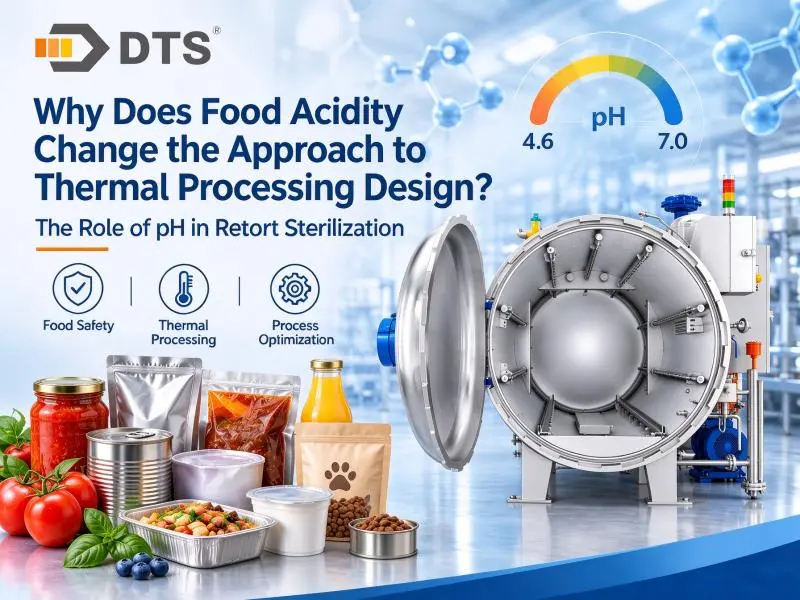
Selecting the right sterilization equipment is an important decision for food manufacturers that process products in sealed containers. Different packaging materials respond differently to heat, pressure, and cooling conditions. Choosing equipment that matches the product and packaging format helps maintain food safety, protect container integrity, and achieve consistent production results.
An Autoclave Food Sterilizer is designed to apply controlled thermal treatment to packaged food products under regulated temperature and pressure conditions. However, not every autoclave configuration is suitable for every type of packaging. Manufacturers should consider container material, size, product characteristics, heat transfer requirements, and production capacity before selecting a system.
Understanding the Role of an Autoclave Food Sterilizer
An autoclave food sterilizer is an industrial system used to process sealed food products through controlled heating. The purpose is to achieve the required level of microbial control while maintaining the quality and integrity of the packaged product.
Depending on the equipment design, sterilization may use steam, hot water, water spray, or other suitable heating arrangements.
These systems are commonly used for products packaged in:
- Metal cans
- Glass jars and bottles
- Retort pouches
- Heat-resistant plastic trays
- Semi-rigid plastic containers
The appropriate sterilization method depends on the packaging material, food formulation, container dimensions, and validated processing requirements.
Why Packaging Format Matters When Selecting an Autoclave
Packaging has a direct influence on how heat moves into a food product and how the container responds to pressure changes.
A sterilization system that works well for metal cans may require different operating conditions when processing flexible pouches or glass containers.
Several packaging-related factors should be evaluated.
Material Heat Resistance
Packaging materials must withstand the temperatures required for the intended sterilization process.
Some plastics are designed specifically for retort processing, while conventional food-grade plastics may deform or lose their structural properties under high temperatures.
Pressure Resistance
During heating and cooling, pressure conditions inside and outside a container can change.
The equipment must provide suitable pressure management to reduce the risk of container deformation, seal damage, or breakage.
Container Shape and Dimensions
The size and shape of a package influence heat penetration and the time required to achieve the target thermal treatment.
Large containers may require different processing schedules from smaller packages containing the same food.
Product Characteristics
Food composition also affects heat transfer.
Liquid products, solid foods, thick sauces, and mixed meals can have different heating behaviors. These differences should be considered when establishing processing conditions.
Selecting an Autoclave for Different Packaging Formats
Each packaging format has specific requirements that should guide equipment selection.
1. Metal Cans
<text>Metal cans are widely used for commercially sterilized vegetables, meat, seafood, soups, and other packaged foods.</text>
Their rigid construction allows them to withstand suitable retort processing conditions when the can and closure are properly specified.
Important selection considerations:
- Compatibility with the can dimensions and loading arrangement
- Suitable heating capacity for the intended production volume
- Consistent heat distribution throughout the chamber
- Appropriate pressure control during processing and cooling
- Loading baskets designed to accommodate the cans securely
Steam or water-based retort systems may be suitable depending on the product, can design, and process requirements.
2. Glass Jars and Bottles
Glass packaging is commonly used for sauces, preserved vegetables, baby food, and other processed products.
Although glass can tolerate high temperatures when properly manufactured, it can be sensitive to sudden temperature changes and pressure differences.
Important selection considerations:
- Controlled heating and cooling rates
- Suitable pressure management
- Secure loading arrangements that prevent container movement
- Compatibility with jar dimensions and closure systems
- Protection against thermal shock
Water-based sterilization systems are often considered for glass containers because they can provide controlled heating and cooling. The exact configuration should be confirmed through packaging and process testing.
3. Retort Pouches
Retort pouches are flexible, multilayer packages designed for suitable high-temperature food processing.
They are commonly used for ready-to-eat meals, meat products, seafood, sauces, and other convenience foods.
Important selection considerations:
- Compatibility with flexible packaging materials
- Uniform heat distribution around the pouch surfaces
- Suitable support racks or baskets
- Appropriate overpressure control during heating and cooling
- Loading arrangements that prevent pouches from overlapping excessively
Water spray and water immersion retort systems can be suitable for compatible pouches, depending on the equipment design and validated process.
4. Heat-Resistant Plastic Trays
Rigid or semi-rigid plastic trays are used for packaged meals, prepared foods, and other convenience products.
These containers require careful control because their shape and material properties can change under high-temperature processing.
Important selection considerations:
- Verified retort-grade packaging material
- Compatibility with the required processing temperature
- Pressure control to protect tray shape and sealing integrity
- Suitable tray holders or loading baskets
- Cooling conditions that minimize deformation
Manufacturers should confirm the packaging supplier’s temperature and pressure specifications before selecting equipment.
5. Semi-Rigid Plastic Containers
Some food products are packaged in specialized semi-rigid containers designed for thermal processing.
Their performance depends on material composition, wall thickness, sealing method, and container geometry.
Important selection considerations:
- Compatibility with the retort’s operating conditions
- Reliable control of pressure differences
- Suitable container support during processing
- Verification of seal performance after sterilization
- Product-specific heat penetration testing
Not all plastic containers are suitable for autoclave processing, so packaging specifications should be reviewed carefully.
Common Autoclave Heating Systems and Their Applications
Different retort technologies provide different methods of transferring heat to packaged food products.
Steam Retorts
Steam retorts use saturated steam as the heating medium.
They can be suitable for compatible rigid containers, particularly where the packaging can tolerate the required temperature and pressure conditions.
Their performance depends on proper air removal, steam distribution, temperature control, and process validation.
Water Spray Retorts
Water spray retorts circulate heated water through spray nozzles positioned inside the chamber.
This method can support processing of different packaging formats when the equipment is designed for the relevant containers.
Water distribution, circulation capacity, and nozzle positioning are important factors in achieving consistent heating conditions.
Water Immersion Retorts
Water immersion systems use heated water to surround the packaged products.
They may be suitable for containers that benefit from controlled water-based heating and cooling.
The system must provide appropriate water circulation, temperature control, and pressure management.
Steam-Air Retorts
Steam-air retorts use a controlled mixture of steam and air as the heating medium.
They can be useful for certain packaging formats that require overpressure during processing, including compatible flexible and semi-rigid containers.
Air circulation and pressure control must be carefully managed to maintain suitable thermal conditions.
Key Technical Factors to Evaluate Before Purchasing
Selecting an autoclave requires more than matching the equipment to a packaging category. Manufacturers should also evaluate the following technical factors.
Processing Capacity
Determine the required number of containers per cycle and the facility’s daily production target.
Chamber size should accommodate the intended product load without restricting circulation or compromising the approved loading arrangement.
Temperature and Pressure Control
The system should maintain the required operating conditions throughout heating, sterilization, and cooling.
Accurate sensors and reliable controls help support repeatable processing cycles.
Heat Distribution Performance
Temperature distribution should be evaluated throughout the chamber under representative loading conditions.
This is especially important when processing multiple container sizes or different loading levels.
Automation and Data Recording
Automated systems can manage processing stages and record important operating parameters.
Useful functions may include:
- Programmable processing recipes
- Temperature and pressure monitoring
- Automatic heating and cooling control
- Alarm notifications
- Batch records and process documentation
These features can support production consistency and quality management.
Utility and Installation Requirements
Manufacturers should review the available steam, water, electricity, compressed air, drainage, and floor-space requirements.
The equipment should fit the facility’s infrastructure and production workflow.
Maintenance and Technical Support
Spare parts availability, calibration services, maintenance requirements, and technical assistance can influence long-term operating reliability.
These factors should be assessed alongside the initial purchase price.
How to Match Packaging Formats with Retort Technology
The following table provides a general comparison of packaging formats and important equipment considerations.
| Packaging format | Main consideration | Suitable system options to evaluate |
|---|---|---|
| Metal cans | Heat distribution and pressure control | Steam, water spray, or immersion retorts |
| Glass jars | Controlled temperature changes | Water spray or immersion retorts |
| Retort pouches | Flexible-package support and overpressure | Water spray, immersion, or steam-air retorts |
| Plastic trays | Material resistance and seal protection | Compatible water spray or steam-air systems |
| Semi-rigid containers | Container stability and pressure management | Systems specifically designed for the packaging |
This comparison is a starting point rather than a universal equipment specification. Final selection should be based on packaging validation, product characteristics, and the sterilization process requirements.
The Importance of Heat Penetration and Process Validation
A suitable autoclave must do more than reach the target chamber temperature. It must deliver the required thermal treatment to the product inside each package.
Heat penetration depends on several variables, including:
- Food composition and viscosity
- Container dimensions and geometry
- Initial product temperature
- Product filling weight
- Headspace and internal arrangement
- Heating medium and circulation pattern
Manufacturers should conduct temperature distribution studies to evaluate conditions throughout the chamber. Product-specific heat penetration studies are also necessary to establish appropriate processing schedules.
For low-acid packaged foods, qualified thermal processing specialists should determine the required process in accordance with applicable food safety regulations.
Changing packaging materials, container sizes, formulations, or loading patterns may require reassessment of the validated process.
Common Mistakes to Avoid When Choosing an Autoclave
Incorrect equipment selection can create production problems and increase operational costs.
Common mistakes include:
- Choosing equipment based only on chamber size: Capacity should not come at the expense of proper loading and heat distribution.
- Ignoring packaging specifications: Not every plastic container or pouch is designed for retort processing.
- Overlooking pressure requirements: Flexible and semi-rigid packages may require carefully controlled overpressure.
- Assuming one process fits every product: Different food formulations and container dimensions can require different sterilization schedules.
- Neglecting cooling performance: Improper cooling can damage packaging even when the heating stage is satisfactory.
- Ignoring maintenance needs: Poorly maintained pumps, valves, sensors, and nozzles can affect process reliability.
- Skipping process validation: Equipment capability does not automatically prove that a particular food product receives sufficient thermal treatment.
Avoiding these mistakes helps manufacturers make more informed equipment decisions.
Conclusion
Selecting an autoclave food sterilizer for different packaging formats requires careful evaluation of container materials, product characteristics, heating methods, pressure requirements, and production capacity. Metal cans, glass jars, retort pouches, and plastic trays each have different processing needs that should be matched with a suitable retort configuration.
Manufacturers should also consider automation, temperature distribution, cooling performance, maintenance requirements, and technical support when comparing equipment options.
Most importantly, the selected system and processing schedule must be validated for the actual product and packaging combination. With suitable equipment selection and effective process control, food manufacturers can support reliable sterilization, protect packaging integrity, and maintain consistent product quality.