
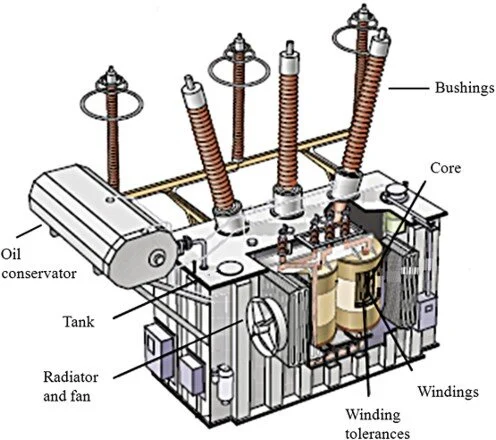
Power transformers are essential components of modern electrical infrastructure, enabling electricity to move efficiently between different voltage levels. They are widely used in power generation facilities, transmission networks, industrial plants, and large substations. By adjusting voltage according to system requirements, these devices help reduce transmission losses and support reliable electricity delivery over long distances.
Understanding how a Power Transformer works, the types available, and where each design is used can help engineers, project developers, and equipment buyers make informed decisions. Selecting the appropriate transformer requires consideration of electrical ratings, operating conditions, efficiency, safety, and long-term maintenance needs.
What Is a Power Transformer?
A power transformer is a static electrical device that transfers electrical energy between two or more circuits through electromagnetic induction. It typically operates with alternating current (AC) and changes voltage and current levels while maintaining the same frequency.
Power transformers are commonly installed at generating stations and transmission substations, where electricity must be transferred between voltage levels. They may also be used in large industrial facilities that require substantial electrical capacity.
Unlike electrical generators or motors, transformers have no rotating components. Their operation relies primarily on magnetic fields, conductive windings, and an insulated magnetic core.
How Does a Power Transformer Work?
The working principle of a transformer is based on electromagnetic induction. When alternating current flows through the primary winding, it produces a changing magnetic flux in the core. This changing flux links with the secondary winding and induces a voltage across it.
The relationship between the primary and secondary voltages depends largely on the number of turns in each winding.
For an ideal transformer, the voltage ratio is expressed as:
[
\frac{V_s}{V_p}=\frac{N_s}{N_p}
]
Where:
- (V_s) represents the secondary voltage.
- (V_p) represents the primary voltage.
- (N_s) represents the number of secondary winding turns.
- (N_p) represents the number of primary winding turns.
If the secondary winding has more turns than the primary winding, the transformer increases voltage. If it has fewer turns, the transformer reduces voltage.
In practical equipment, some energy is lost through winding resistance, core losses, and other effects. Good transformer design minimizes these losses while maintaining suitable temperature, insulation, and operating performance.
Main Components of a Power Transformer
A power transformer contains several components that work together to transfer electricity safely and efficiently.
Magnetic Core
The core provides a low-reluctance path for magnetic flux between the windings. It is commonly constructed from laminated electrical steel designed to reduce energy losses caused by eddy currents.
Core material and construction influence no-load losses, noise, and overall transformer performance.
Primary and Secondary Windings
The windings carry electrical current and create the magnetic coupling needed for energy transfer. They are generally made from copper or aluminum conductors, depending on the design and performance requirements.
Their insulation, arrangement, and mechanical strength are important for handling operating temperatures and electromagnetic forces during short-circuit events.
Insulation System
Insulation separates energized components from one another and from grounded structures. Depending on the transformer design, insulation may include solid materials, insulating liquids, or a combination of both.
A suitable insulation system helps prevent electrical breakdown and supports long-term reliability.
Cooling System
Transformers generate heat during operation. Cooling systems remove this heat to maintain acceptable operating temperatures.
Depending on the design, cooling may use natural air circulation, forced air, natural oil circulation, or forced liquid circulation. The appropriate arrangement depends on transformer capacity, installation conditions, and expected loading.
Tank and Protective Accessories
Oil-immersed transformers typically use a tank to contain the core, windings, and insulating liquid. Depending on the design, accessories may include temperature indicators, pressure-relief devices, liquid-level indicators, and protective relays.
These components help operators monitor operating conditions and identify abnormalities before they cause significant damage.
Common Types of Power Transformers
Power transformers are available in several configurations to meet different electrical and environmental requirements.
Step-Up Transformers
Step-up transformers increase voltage from a lower level to a higher level. They are commonly installed at power generation facilities, where electricity from generators must be raised to transmission voltage.
Higher transmission voltage allows the same amount of power to be transferred at lower current, reducing resistive losses in transmission conductors for a given power level.
Step-Down Transformers
Step-down transformers reduce voltage to a level suitable for downstream substations, industrial facilities, or distribution networks.
They are widely used in transmission substations and large electrical installations where equipment must receive electricity at a specific voltage.
Oil-Immersed Power Transformers
Oil-immersed transformers use insulating liquid for both cooling and electrical insulation. They are commonly selected for high-capacity applications and outdoor substations.
Their advantages can include effective heat transfer and suitability for demanding power applications. However, buyers must consider liquid maintenance, leak prevention, fire protection, and environmental requirements.
Dry-Type Transformers
Dry-type transformers use air and solid insulation rather than insulating oil. They may be appropriate for indoor installations, commercial buildings, industrial facilities, and locations where liquid containment is undesirable.
Their performance depends on adequate ventilation, insulation quality, ambient temperature, and the installation environment. Not every dry-type design is intended for the same power capacity or operating conditions.
Single-Phase and Three-Phase Transformers
Single-phase transformers serve circuits that use single-phase AC power. Three-phase transformers are widely used in industrial facilities and electrical networks that distribute three-phase power.
The choice depends on the system configuration, capacity requirements, and intended application.
Autotransformers
An autotransformer uses a shared winding for its input and output circuits rather than separate primary and secondary windings throughout the design.
It can be economical and compact for certain voltage ratios. However, it does not provide the same electrical isolation between input and output as a conventional two-winding transformer, which can be a critical consideration in equipment selection.
Major Applications of Power Transformers
Power transformers support a wide range of electrical systems, from national transmission networks to large industrial operations.
Power Generation Stations
Generating stations use transformers to increase generator output voltage before electricity enters the transmission network. This helps improve transmission efficiency and allows electricity to be delivered over long distances.
Transformer selection must account for generator ratings, system voltage, load variations, protection requirements, and the operating conditions of the generating facility.
Transmission and Distribution Substations
Substations use transformers to transfer electricity between voltage levels as power moves through the electrical network. These facilities may connect generation plants to transmission lines or supply lower-voltage networks serving towns, cities, and industrial areas.
Reliable transformer operation is essential for maintaining network stability and reducing the risk of widespread supply interruptions.
Industrial Facilities
Large factories, mines, processing plants, and manufacturing facilities may require power transformers to supply heavy machinery and extensive electrical distribution systems.
Correct sizing and protection coordination help ensure that transformers can handle expected loads, motor starting conditions, and other electrical demands.
Renewable Energy Installations
Solar farms and wind power projects use transformers to connect generation equipment to collection networks and the electrical grid. Transformer specifications must account for the output characteristics of inverters, grid voltage requirements, and expected operating conditions.
Renewable energy installations may also require specialized monitoring and protection arrangements to maintain reliable operation.
Commercial and Infrastructure Projects
Large commercial buildings, transport facilities, data centers, and public infrastructure projects may use transformers as part of their electrical supply systems.
The required design depends on power demand, available supply voltage, redundancy requirements, installation space, and applicable safety regulations.
Factors to Consider When Selecting a Power Transformer
Choosing the right transformer requires a thorough assessment of electrical, mechanical, environmental, and economic requirements.
Rated Capacity
Transformer capacity is generally expressed in kilovolt-amperes (kVA) or megavolt-amperes (MVA). The rating should accommodate the expected load without exceeding permissible operating limits.
Engineers should consider current demand, future expansion, ambient temperature, and permitted loading conditions when determining the required capacity.
Voltage Ratio and Frequency
The primary and secondary voltage ratings must match the connected electrical system. Frequency is also important because transformers are designed to operate within specified electrical and magnetic conditions.
Incorrect voltage or frequency selection can lead to excessive magnetic flux, overheating, or unsuitable operating performance.
Efficiency and Energy Losses
Transformer losses influence operating costs throughout the equipment’s service life. The two principal categories are no-load losses, which occur when the transformer is energized, and load losses, which vary with current.
Comparing guaranteed loss values helps buyers evaluate the long-term economic impact of different designs. Expected loading and annual operating hours should be included in the assessment.
Cooling and Insulation
The cooling arrangement must be suitable for the transformer’s rating and the site’s environmental conditions. Insulation design should account for voltage stresses, operating temperature, moisture exposure, and the required dielectric performance.
These factors influence equipment reliability, maintenance requirements, and expected service life.
Protection and Monitoring
Transformers may require protection against internal faults, overcurrent, excessive temperature, and abnormal pressure, depending on their design and application.
Monitoring equipment can provide information about temperature, loading, insulating liquid condition, and other operating parameters. These measurements help maintenance teams identify potential problems and plan inspections.
Transformer Efficiency and Energy Losses
Transformer efficiency describes how much of the input electrical power is transferred to the output rather than lost within the equipment.
Efficiency can be expressed as:
[
\eta=\frac{P_{\text{out}}}{P_{\text{in}}}\times100%
]
Where (P_{\text{out}}) is the output power and (P_{\text{in}}) is the input power.
Although well-designed power transformers can achieve very high efficiency, even small losses can accumulate into substantial energy costs over years of operation.
Core material, winding resistance, operating temperature, loading patterns, and transformer design all influence performance. Selecting equipment based on guaranteed losses and lifecycle cost can therefore provide greater long-term value than comparing purchase prices alone.
Maintenance Practices for Reliable Performance
Regular maintenance helps preserve transformer efficiency and reduces the likelihood of unexpected failure. Maintenance requirements depend on the transformer type, operating conditions, manufacturer recommendations, and the criticality of the installation.
Common activities include:
- Inspecting bushings, terminals, grounding connections, and external components.
- Monitoring temperature and loading conditions.
- Checking cooling equipment and ventilation pathways.
- Examining insulating liquid condition in oil-immersed transformers.
- Testing protection devices and associated control circuits.
- Reviewing alarms, inspection records, and unusual operating trends.
For critical installations, condition monitoring and planned testing can help identify deterioration before it leads to a major outage. All maintenance work should follow approved safety procedures and be carried out by qualified personnel.
Standards and Safety Requirements
Power transformers must meet the standards and regulatory requirements applicable to their intended use. The IEC 60076 series covers power transformers and includes requirements for different aspects of design, testing, and performance.
Depending on the project, additional requirements may address insulation coordination, fire safety, noise, environmental protection, energy efficiency, and utility-specific operating conditions.
Buyers and engineers should confirm the required standards, obtain relevant test documentation, and verify that the proposed equipment matches the project’s technical specifications. Appropriate installation, grounding, protection, and commissioning are equally important for safe operation.
Conclusion
Power transformers are fundamental to modern electricity systems, enabling voltage conversion, efficient transmission, and reliable power distribution across numerous applications. Their operation relies on electromagnetic induction, while their performance depends on core construction, winding design, insulation, cooling, and protective systems.
Understanding the available transformer types and their applications helps engineers and buyers choose equipment that meets their electrical requirements. By evaluating capacity, voltage ratings, efficiency, environmental conditions, standards compliance, and maintenance needs, organizations can improve reliability and manage the long-term cost of their electrical infrastructure.