
Introduction
For furniture manufacturers, cabinet factories, distributors, and international importers, choosing the right particle board is an important decision that directly affects production efficiency, product quality, and long-term business performance.
In large-scale furniture production, particle board is not simply a raw material. The consistency of the board affects every stage of manufacturing, including CNC cutting, drilling, edge banding, assembly, and final product quality.
Many buyers focus mainly on purchase price when sourcing particle board from China. However, a lower price does not always mean lower total cost. Inconsistent density, unstable thickness, poor surface quality, or unreliable supply can increase material waste, delay production schedules, and affect customer satisfaction.
For this reason, professional furniture manufacturers and importers need to evaluate more than product pricing. They should consider material performance, production capability, quality control systems, certifications, and long-term supply reliability when selecting a trusted particle board supplier.
This buying guide explains the key factors global furniture companies should understand before purchasing particle board from China, helping buyers make better sourcing decisions and build a more stable supply chain.
Why Particle Board Quality Matters for Furniture Manufacturing
For furniture manufacturers, the performance of particle board directly influences production efficiency and finished product quality.
Unlike simple construction materials, furniture panels need to meet strict requirements during manufacturing processes such as cutting, drilling, screw fixing, laminating, and edge finishing.
A reliable furniture grade particle board should provide:
- Stable density across different production batches
- Accurate thickness tolerance
- Good machining performance
- Strong screw-holding ability
- Suitable surface quality for decorative finishing
Poor-quality particle board may create problems during production, including:
- Higher cutting waste
- Edge damage during processing
- Difficulty during assembly
- Inconsistent appearance between finished products
- Increased production costs
For cabinet factories and furniture producers, material consistency is especially important because even small variations in board performance can affect automated production lines.
This is why experienced buyers usually focus on overall supply reliability rather than simply choosing the lowest-priced material.
A professional particle board supplier should understand the requirements of furniture manufacturing and provide products that match different applications, from kitchen cabinets and wardrobes to office furniture and commercial projects.
Key Specifications Furniture Manufacturers Should Check Before Buying Particle Board
Before placing bulk orders, furniture companies should evaluate several important technical factors.
1. Density Consistency
Density is one of the most important indicators of particle board performance.
A stable density structure affects:
- Panel strength
- Screw-holding performance
- Machining quality
- Furniture durability
For large furniture manufacturers, inconsistent density between batches may lead to different processing results and increased production adjustments.
Therefore, buyers should confirm whether suppliers have standardized production processes and quality inspection procedures.
2. Thickness Accuracy
Thickness consistency is critical for furniture production.
Modern factories often use:
- CNC cutting machines
- Automatic drilling equipment
- Edge banding machines
Small thickness variations can affect:
- Component matching
- Assembly accuracy
- Finished product appearance
Reliable manufacturers should maintain strict thickness control to ensure stable production performance.
3. Surface Quality
For decorative furniture applications, surface quality directly affects the final appearance.
Buyers should evaluate:
- Surface flatness
- Smoothness
- Compatibility with melamine finishing
- Defect control
For manufacturers producing cabinets, wardrobes, and office furniture, stable surface quality helps reduce rejection rates and improve production efficiency.
4. Environmental Standards and Emission Requirements
For international furniture markets, environmental compliance is becoming increasingly important.
Importers and distributors should confirm whether suppliers can provide suitable certifications and testing documentation.
Common requirements include:
- FSC certification
- CARB P2 compliance
- ISO9001 quality management system
Working with a supplier that understands international standards helps furniture companies avoid compliance risks when entering different markets.
5. Packaging and Export Preparation
For international buyers, product quality is only one part of successful sourcing.
Proper export packaging is also important because particle board needs protection during:
- Container loading
- Ocean transportation
- Warehouse handling
Experienced suppliers should understand export requirements and provide suitable packaging solutions to minimize damage during shipment.
Why Furniture Companies Choose China Particle Board Factories for Bulk Supply
For international furniture manufacturers, cabinet factories, and distributors, sourcing from a reliable China particle board factory can provide significant advantages in terms of production stability, customization capability, and supply chain efficiency.
China has become one of the major global sources of wood-based panels because manufacturers can provide large-scale production capacity, flexible specifications, and competitive solutions for different furniture applications.
However, successful sourcing is not only about finding a factory with low prices. Buyers should evaluate whether the manufacturer can consistently deliver the required quality, production volume, and service support.
The following factors are especially important for companies purchasing particle board in bulk.
1. Stable Production Capacity for Long-Term Supply
For furniture manufacturers, supply interruptions can directly affect production schedules and customer delivery commitments.
A qualified particle board manufacturer should have:
- Sufficient production capacity
- Stable raw material supply
- Standardized manufacturing processes
- Professional quality control procedures
This is particularly important for:
- Large furniture manufacturers
- Cabinet factories
- Furniture distributors
- Importers managing multiple markets
A factory with strong production capability can better support recurring container orders and seasonal demand changes.
2. Better Customization Options for Different Furniture Applications
Different furniture products require different panel specifications.
For example:
- Kitchen cabinet manufacturers may require specific thickness and surface finishes.
- Wardrobe producers may focus on appearance and machining performance.
- Office furniture companies may need consistent quality for large commercial projects.
Working directly with experienced manufacturers allows buyers to discuss:
- Thickness options
- Board sizes
- Density requirements
- Surface finishing
- Packaging solutions
This flexibility is especially valuable for brands and wholesalers that need products adapted to their target markets.
3. More Effective Quality Control Management
When purchasing large volumes, quality consistency becomes more important than individual sample performance.
A professional manufacturer should have quality control procedures covering:
- Raw material inspection
- Production monitoring
- Thickness measurement
- Density testing
- Final product inspection
For furniture factories, stable quality reduces:
- Production adjustments
- Material waste
- Customer complaints
Therefore, buyers should evaluate not only the product sample but also the supplier’s manufacturing process behind the sample.
Wholesale Particle Board Buying: What Importers and Distributors Need to Know
For wholesalers and distributors, purchasing particle board is different from buying small quantities for individual projects.
Bulk buyers need to consider supply reliability, logistics efficiency, and long-term cooperation.
A successful particle board wholesale strategy requires evaluating several key factors.
1. Order Volume and Container Planning
Most international buyers purchase particle board through container shipments.
Before cooperation, buyers should confirm:
- Minimum order quantity requirements
- Container loading efficiency
- Production lead time
- Monthly supply capability
A supplier that understands bulk export requirements can help buyers optimize purchasing plans and reduce unnecessary logistics costs.
2. Product Range and Market Flexibility
Distributors often serve different customer groups, so product flexibility is important.
A capable supplier may provide different options, including:
- Plain particle board
- Melamine faced particle board
- Furniture-grade panels
- Different thickness specifications
This allows distributors to build a broader product portfolio for different markets.
3. Export Experience and Documentation Support
International purchasing involves more than production.
Experienced suppliers should understand:
- Export documentation
- International packaging requirements
- Shipping coordination
- Market-specific compliance requirements
For importers, working with an export-experienced manufacturer reduces communication problems and improves purchasing efficiency.
Plain Chipboard Supplier Guide: Understanding Different Market Requirements
In many markets, especially Europe and some international furniture industries, buyers use the term plain chipboard supplier instead of particle board supplier.
Although the terminology may differ, both terms generally refer to engineered wood panels made from wood particles bonded with resin under pressure.
Understanding these different search terms and market preferences helps buyers communicate more effectively with suppliers.
Particle Board vs Chipboard: Different Names, Similar Applications
Depending on the region, buyers may search for:
- Particle board
- Chipboard
- Plain chipboard
- Furniture board
The preferred terminology often depends on local industry habits.
For example:
- European buyers commonly use “chipboard”.
- North American buyers often use “particle board”.
- Furniture manufacturers may search based on application, such as furniture-grade panels.
A professional plain chipboard supplier should understand these market differences and provide products suitable for regional requirements.
Applications of Plain Particle Board
Plain chipboard is widely used for:
- Cabinet production
- Wardrobes
- Office furniture
- Shelving systems
- Interior furniture components
For manufacturers, choosing the correct panel specification is essential because different applications require different levels of strength, surface quality, and processing performance.
Common Mistakes When Importing Particle Board from China
Even experienced buyers can face challenges when sourcing internationally. Avoiding common mistakes can help companies build more reliable supply relationships.
Mistake 1: Focusing Only on Purchase Price
Price is important, but it should not be the only factor.
A cheaper product may create additional costs through:
- Higher waste rate
- Production delays
- Quality problems
- Customer returns
The real purchasing cost should include overall production efficiency and supply reliability.
Mistake 2: Evaluating Only Samples Instead of Manufacturing Capability
A good sample does not always guarantee consistent bulk production.
Before placing large orders, buyers should understand:
- Factory production capability
- Quality control systems
- Previous export experience
- Ability to maintain consistency
Mistake 3: Ignoring Long-Term Supply Requirements
Furniture businesses often grow over time.
A supplier that can support only one small order may not be suitable for long-term cooperation.
Buyers should consider whether the supplier can support:
- Increasing order volumes
- New product requirements
- Different market standards
How to Select Particle Board for Different Furniture Applications
Choosing the right particle board depends not only on product specifications but also on the final application.
Different furniture manufacturers have different requirements for strength, appearance, machining performance, and surface finishing.
For example, a kitchen cabinet producer may prioritize moisture resistance and surface durability, while an office furniture manufacturer may focus more on consistent quality and cost efficiency for large-scale production.
Selecting the correct furniture grade particle board can help manufacturers improve production efficiency and achieve better final product performance.
Particle Board for Kitchen Cabinets
Kitchen cabinets require panels with stable structure, good machining performance, and suitable surface quality.
Important considerations include:
- Density consistency
- Screw holding strength
- Moisture resistance
- Surface compatibility with decorative finishes
For cabinet factories, stable particle board quality is especially important because panels usually undergo multiple processes, including:
- CNC cutting
- Drilling
- Edge banding
- Hardware installation
A consistent board structure helps reduce processing issues and improves assembly efficiency.
Particle Board for Wardrobes and Bedroom Furniture
Wardrobes and bedroom furniture often require a balance between appearance, performance, and cost efficiency.
Manufacturers typically consider:
- Smooth surface quality
- Accurate thickness
- Stable dimensions
- Compatibility with melamine finishes
For these applications, furniture grade particle board is commonly selected because it provides suitable performance for large-scale furniture production.
Particle Board for Office and Commercial Furniture
Office furniture manufacturers often handle large projects requiring consistent material supply.
For these buyers, important factors include:
- Stable bulk availability
- Uniform quality across production batches
- Competitive cost structure
- Reliable delivery schedules
A dependable supplier helps manufacturers maintain consistent production standards when fulfilling large commercial orders.
How Fortuna Supports Global Furniture Manufacturers with Reliable Particle Board Supply
For furniture manufacturers, cabinet factories, distributors, and importers, choosing the right particle board supplier means finding a partner that can provide consistent quality, stable production capacity, and reliable long-term supply.
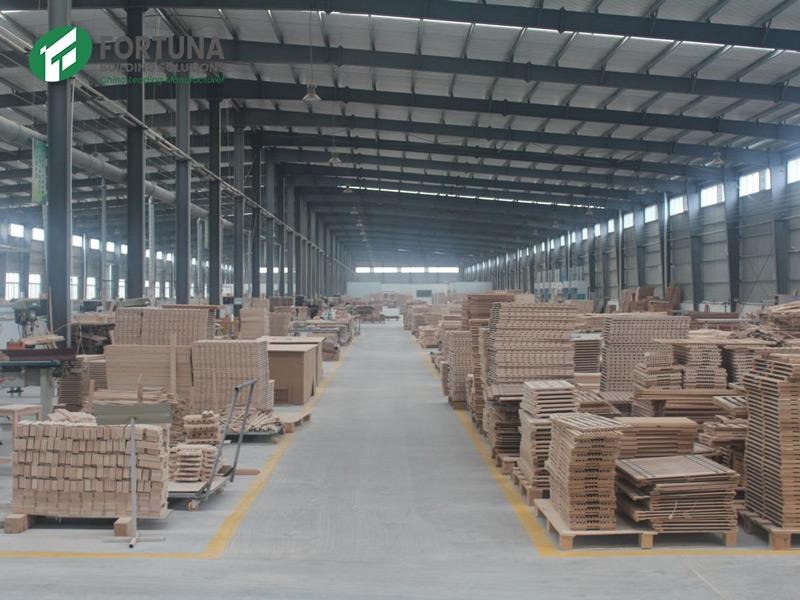
Fortuna is a China-based wood panel manufacturer specializing in particle board, plywood, MDF, and melamine board solutions for global furniture and interior industries.
Since 1993, Fortuna has supported customers in 170+ countries with factory-direct wood panel supply from Linyi, China. With a 20,800㎡+ production base and extensive export experience, Fortuna provides stable bulk supply solutions for furniture manufacturers, wholesalers, and distributors.
To meet international purchasing requirements, Fortuna offers:
- FSC, CE, CARB P2, and EUDR-compliant wood panel solutions
- Professional quality control for consistent production batches
- OEM cooperation and customized particle board specifications
- Flexible options for thickness, panel dimensions, and surface finishes based on customer requirements
By combining manufacturing experience, export capability, and quality management, Fortuna helps global furniture companies reduce sourcing risks and build more reliable particle board supply chains.
FAQ About Particle Board Wholesale for Furniture Manufacturers
- What is the difference between standard particle board and furniture grade particle board?
Furniture grade particle board is specifically designed for furniture manufacturing applications where processing performance, surface quality, and dimensional stability are important.
Compared with general-purpose particle board, furniture-grade panels typically require:
- More consistent density structure
- Better screw-holding performance
- Stable thickness tolerance
- Improved surface quality for finishing
For cabinet factories and furniture manufacturers, selecting the right grade of particle board helps improve CNC machining, edge processing, assembly efficiency, and final product consistency.
- What thickness of particle board is commonly used for furniture production?
The most commonly used particle board thickness depends on the furniture application and manufacturing requirements.
Typical choices include:
| Application | Common Thickness |
| Cabinets and wardrobes | 15mm–18mm |
| Office furniture | 16mm–18mm |
| Structural furniture components | 18mm–25mm |
However, professional buyers should select thickness based on product design, load requirements, processing methods, and target market standards rather than choosing only based on price.
A reliable particle board manufacturer should be able to recommend suitable specifications according to the final application.
- How can buyers verify particle board quality before placing a bulk order?
Before purchasing large quantities, buyers should evaluate both product quality and supplier capability.
Important checks include:
- Sample consistency compared with mass production
- Thickness accuracy
- Density stability
- Surface condition
- Moisture resistance requirements
- Formaldehyde emission standards
- Export packaging quality
For international buyers, a reliable particle board supplier should provide clear product specifications, quality documentation, and professional support before shipment.
- Is particle board the same as chipboard?
Yes. In most international markets, particle board and chipboard refer to similar engineered wood panels made from wood particles bonded with resin under pressure.
The terminology mainly depends on regional usage:
- Particle board is commonly used in North America and international trade.
- Chipboard is widely used in Europe and some furniture industries.
- Plain chipboard is often used when buyers are looking for unfinished panels.
Therefore, importers may search for both particle board supplier and plain chipboard supplier when sourcing wood panels.
- What should furniture manufacturers prepare before importing particle board from China?
Before contacting a China particle board factory, buyers should prepare clear purchasing requirements, including:
- Required panel thickness and dimensions
- Furniture application
- Surface requirements
- Expected order volume
- Destination market standards
- Certification requirements
Providing detailed specifications helps suppliers recommend suitable products, prepare accurate quotations, and avoid misunderstandings during production.
For bulk buyers, clear communication at the beginning of cooperation is essential for building a stable supply chain.
- How do furniture manufacturers choose a reliable particle board supplier?
Furniture manufacturers should evaluate suppliers based on more than product pricing.
Key factors include:
- Manufacturing capability
- Production consistency
- Quality control systems
- Export experience
- Certification support
- Long-term supply reliability
For wholesalers and importers purchasing in volume, a dependable particle board wholesale partner can help reduce supply risks, improve production planning, and maintain consistent product quality across repeated orders.
- Can particle board be customized for different furniture applications?
Yes. Professional particle board manufacturers can provide customized solutions based on furniture production requirements.
Customization may include:
- Different thickness specifications
- Panel dimensions
- Surface finishes
- Packaging requirements
- OEM cooperation
This flexibility allows furniture manufacturers to select materials suitable for different applications, including kitchen cabinets, wardrobes, office furniture, and commercial furniture projects.