
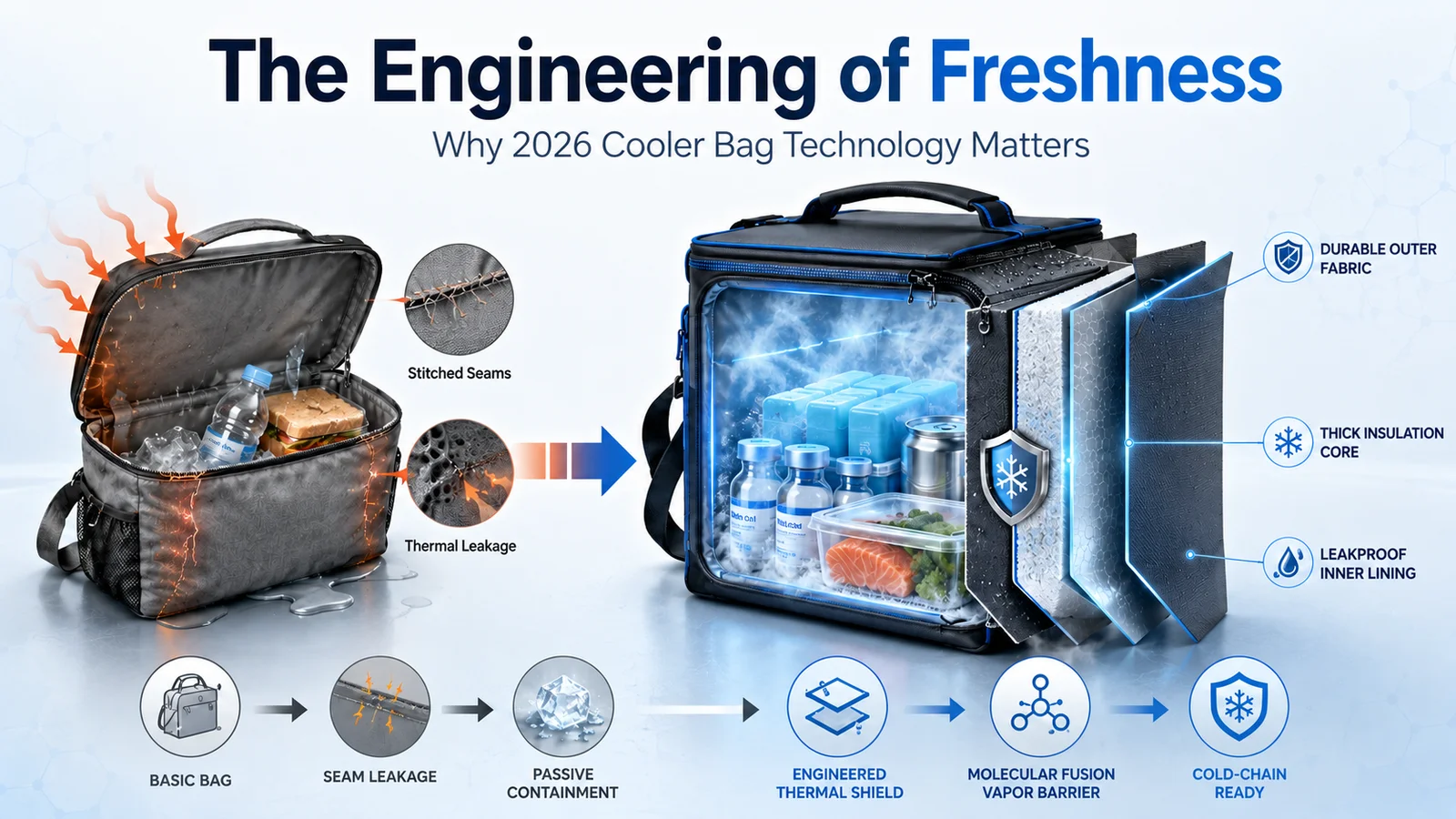
Cooler bags are designed to help keep food, beverages, and other temperature-sensitive items cooler for longer periods. Unlike powered refrigerators, they do not actively produce cold. Instead, they slow the movement of heat from the surrounding environment into the bag.
Understanding How Do Cooler Bags Work starts with the basic principles of insulation and heat transfer. The materials, construction, insulation thickness, closure, and use of ice packs all influence how effectively a cooler bag maintains a lower internal temperature.
The Basic Principle Behind Cooler Bags
A cooler bag works by slowing down heat transfer. When a cold item is placed inside the bag, heat from the warmer surrounding environment naturally attempts to move toward the colder contents.
The insulation creates resistance to this heat flow. As a result, the contents warm up more slowly than they would in an ordinary uninsulated bag.
What Is Insulation?
Insulation is a material or structure that reduces the rate at which heat moves from one area to another. Cooler bags commonly use insulating layers between the outer fabric and inner lining.
The insulation may consist of foam or other materials containing many small air spaces. Because trapped air generally transfers heat less efficiently than solid materials, these structures can help slow heat movement.
How Heat Enters a Cooler Bag
Heat can reach the contents of a cooler bag through several mechanisms. Understanding these processes helps explain why bag construction matters.
Conduction
Conduction occurs when heat moves through materials that are in direct contact. For example, heat from the outside surface can gradually travel through the bag’s outer fabric, insulation, and inner lining.
A thicker or more effective insulating layer can increase resistance to this heat transfer.
Convection
Convection involves the movement of air or another fluid. Inside a cooler bag, warmer air can circulate around the contents and transfer heat.
A well-designed insulated structure can reduce the rate of this process, while keeping the bag closed limits the exchange of internal and external air.
Radiation
Heat can also be transferred through electromagnetic radiation. Some cooler bag designs use reflective layers that can help reflect radiant heat away from the interior.
Reflective surfaces can therefore complement the insulating layer, although they are only one part of the overall thermal design.
Why Insulation Alone Does Not Make Things Cold
A common misconception is that insulation itself creates cooling. It does not. Insulation simply slows heat transfer.
If a warm drink is placed inside an insulated cooler bag, the bag will not make it cold. Similarly, a cold beverage will eventually warm up as heat gradually enters the bag.
For this reason, cooler bags work best when they are loaded with items that have already been chilled.
The Role of Ice Packs
Ice packs are commonly used to provide a cold source inside a cooler bag. They absorb heat as they warm, helping maintain a lower temperature around the stored items.
The effectiveness of an ice pack depends on its size, temperature, material, and how much heat it can absorb. Using an appropriate number and arrangement of cold packs can improve temperature retention.
Why Pre-Chilling Matters
Pre-chilling food and beverages before placing them inside the cooler bag can improve performance. Cold contents require less cooling energy than warm contents.
When warm items are added, they transfer heat to the surrounding air and nearby products. This can cause the internal temperature to rise more quickly.
The Importance of the Inner Lining
The interior lining serves several purposes beyond appearance. It can help create a cleanable surface and form part of the bag’s overall thermal structure.
Depending on the design, the lining may also provide moisture resistance and help protect the insulation from spills or condensation.
Why the Closure Matters
The opening is one of the most important areas of a cooler bag. Every time the bag is opened, warmer outside air can enter and cooler air can escape.
A well-fitting zipper or other closure can help limit unnecessary air exchange. Keeping the bag closed as much as possible is therefore an important part of maintaining its internal temperature.
How Bag Size Affects Cooling Performance
The amount of empty space inside a cooler bag can influence temperature retention. A bag that is much larger than its contents may contain more air that can warm up.
At the same time, overcrowding can make it difficult to arrange cold packs effectively. Choosing an appropriate size allows the available space to be used more efficiently.
Why Reflective Layers Are Used
Some insulated bags include a reflective interior layer. Its purpose is to reflect a portion of radiant heat rather than simply relying on conventional insulation.
Reflective materials are most useful when combined with other insulation and an appropriate bag structure. They should not be viewed as a substitute for adequate insulation.
Factors That Affect Cooler Bag Performance
Several conditions can influence how long a cooler bag keeps its contents cold:
- Ambient temperature
- Thickness and type of insulation
- Quantity and temperature of ice packs
- Frequency of opening
- Amount of food or beverages inside
- Bag size
- Quality of the closure
- Exposure to direct sunlight
A cooler bag used in a hot outdoor environment will generally experience greater heat transfer than one kept indoors in a moderate environment.
How to Improve Cooling Performance
Users can improve the effectiveness of an insulated bag by preparing it properly. Pre-chilling the contents, using suitable cold packs, limiting unnecessary opening, and keeping the bag away from direct heat can all help.
Organizing the contents so that cold packs remain close to the items that need cooling can also improve the overall arrangement.
Why Cooler Bag Design Matters
Manufacturers need to consider the complete thermal system rather than focusing on a single material. Outer fabric, insulation, lining, seams, closures, and structural design can all influence performance.
For custom cooler bags, the intended application should guide decisions about insulation thickness, capacity, portability, durability, and moisture resistance.
Conclusion
Cooler bags work by slowing the transfer of heat rather than generating cold. Insulation creates resistance to heat movement, while reflective layers, suitable linings, secure closures, and cold packs can further support temperature retention.
Their performance depends on both the bag’s construction and how it is used. Pre-chilling contents, minimizing opening time, choosing the right size, and using suitable ice packs can help a cooler bag maintain lower temperatures for longer.