

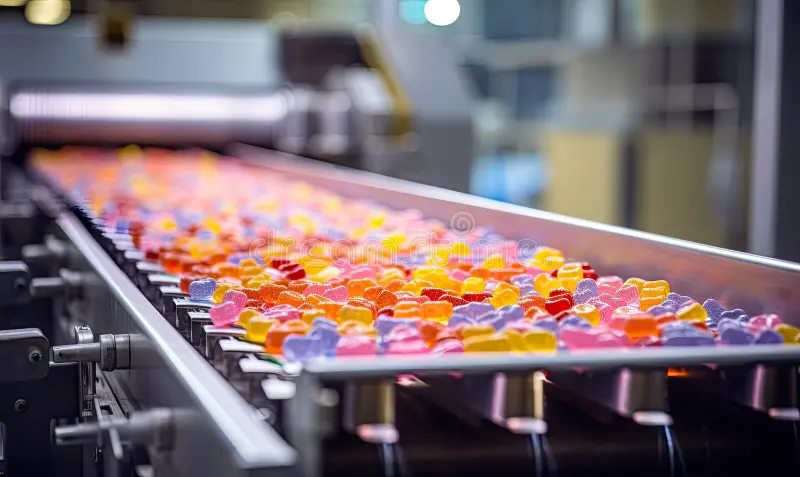
The gummy candy industry is evolving rapidly, and manufacturers face critical decisions when choosing production systems. One of the key considerations is whether to invest in a fully automated gummy candy production line or a semi-automated setup. Both approaches have their advantages and disadvantages, and understanding these differences is crucial for optimizing production efficiency, cost, and product quality. Selecting the right type of system ensures that manufacturers can meet market demands while maintaining consistent output.
A modern Gummy Candy Production Line can range from fully automated systems that handle every stage of production with minimal human intervention to semi-automated setups where operators perform certain tasks manually. Automation level directly impacts labor requirements, production speed, scalability, and overall operational costs. Evaluating the pros and cons of each approach allows manufacturers to make informed decisions based on their specific business needs, production volume, and budget constraints.
Fully Automated Gummy Candy Production Line
A fully automated gummy candy production line integrates all processes, including mixing, cooking, depositing, molding, cooling, coating, and packaging. Advanced control systems monitor parameters such as temperature, viscosity, weight, and shape, ensuring consistent product quality throughout the production cycle.
Pros of Fully Automated Systems
- High Efficiency and Output: Automated lines can operate continuously and produce large volumes of gummy candies with minimal downtime. This is ideal for manufacturers looking to scale up production quickly.
- Consistent Product Quality: Automation reduces human error and ensures uniform texture, shape, flavor, and color across batches.
- Reduced Labor Costs: Since most operations are automated, fewer operators are required, leading to significant cost savings over time.
- Advanced Monitoring and Quality Control: Integrated sensors and monitoring systems detect deviations in real time, minimizing waste and defective products.
- Scalability: Fully automated systems can be upgraded or expanded with additional modules to accommodate growing production needs.
Cons of Fully Automated Systems
- High Initial Investment: Fully automated lines require a significant upfront investment, which may be prohibitive for smaller manufacturers or startups.
- Complex Maintenance: Advanced machinery requires skilled technicians for maintenance and troubleshooting.
- Less Flexibility for Small Batches: Fully automated systems are optimized for large-scale production, making small batch customization more challenging.
Semi-Automated Gummy Candy Production Line
A semi-automated gummy candy production line combines automated machinery for certain stages with manual operations at other points. For instance, mixing and cooking may be automated, while depositing or molding is performed manually.
Pros of Semi-Automated Systems
- Lower Initial Investment: Semi-automated systems are generally more affordable, making them suitable for smaller manufacturers or startups.
- Greater Flexibility: Operators can adjust processes, test new recipes, or create specialty shapes and flavors more easily than in fully automated lines.
- Simpler Maintenance: With fewer complex components, semi-automated systems are easier and less expensive to maintain.
- Incremental Upgrades: Manufacturers can gradually automate additional stages as production demand increases or budgets allow.
Cons of Semi-Automated Systems
- Higher Labor Costs: Manual involvement in certain stages increases labor requirements, which may offset initial savings in some cases.
- Lower Efficiency and Output: Production speed is limited by the manual processes, making it less suitable for high-volume operations.
- Inconsistent Product Quality: Human intervention introduces variability, which can affect gummy texture, shape, or weight.
- Limited Scalability: Semi-automated lines may struggle to meet rapidly increasing demand without further investment in automation.
Factors to Consider When Choosing
When deciding between automation and semi-automation, manufacturers should consider:
- Production Volume: High-volume operations benefit more from full automation, while small or seasonal batches may be suitable for semi-automated lines.
- Budget: Fully automated systems require higher initial capital, whereas semi-automated setups are more cost-effective upfront.
- Product Complexity: If the product requires frequent customization, semi-automation may offer greater flexibility.
- Labor Availability: Automated systems reduce dependence on skilled labor, which can be beneficial in regions with labor shortages.
- Maintenance and Support: Fully automated lines may require specialized technicians, while semi-automated systems are generally easier to maintain.
Conclusion
Both automated and semi-automated Gummy Candy Production Line systems have their advantages and disadvantages. Fully automated lines excel in high efficiency, consistent product quality, and scalability but require significant investment and technical expertise. Semi-automated systems provide flexibility, lower upfront costs, and simpler maintenance but involve higher labor requirements and reduced production speed.
Choosing the right approach depends on the manufacturer’s production goals, budget, labor availability, and long-term growth strategy. By carefully evaluating these factors, confectionery businesses can select a system that optimizes efficiency, supports innovation, and ensures consistent quality while meeting consumer demand.