
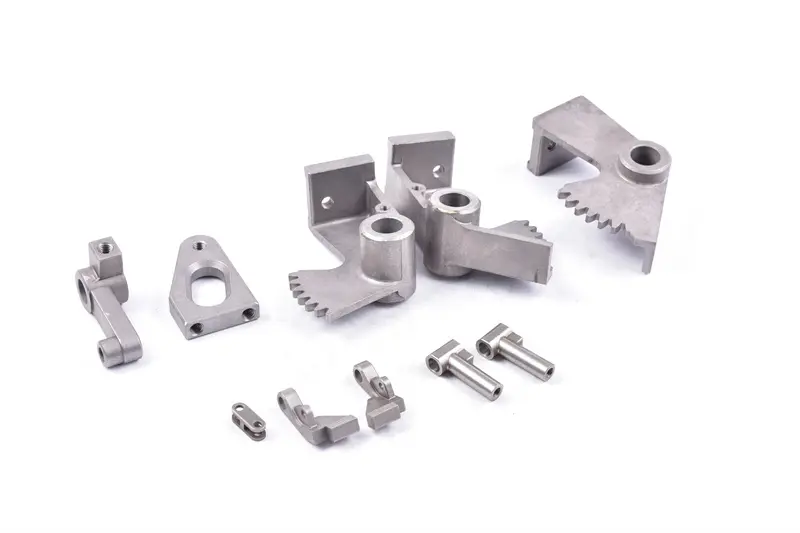
Engineering products increasingly require components that combine compact dimensions, reliable performance, and efficient manufacturing. From small mechanisms inside consumer appliances to functional parts in industrial equipment, manufacturers must select production methods that suit both the component’s design and its operating environment. Powder metallurgy offers an alternative to conventional metalworking by transforming prepared metal powders into solid parts through forming and sintering.
The variety of Powder Metallurgy Products reflects the flexibility of this manufacturing approach. Products can be designed for mechanical movement, shaft support, filtration, and structural functions. Their practical value depends on material composition, density, geometry, dimensional requirements, and the production process selected for the application.
A manufacturing approach based on controlled forming
Powder metallurgy begins with metal powder chosen for the required material properties. The powder may be blended with alloying elements or processing additives before being placed into a die. Pressure compacts the material into a shape known as a green compact.
The compact is then heated under controlled conditions. During sintering, particles bond to form a stronger component. The temperature and atmosphere are selected according to the material system, while the heating and cooling cycles influence the final structure.
This process can create parts close to their intended shape. Depending on the application, additional steps such as sizing, machining, heat treatment, impregnation, or surface finishing may be required.
Mechanical components for compact assemblies
One important application area is mechanical power transmission. Powder metal gears can be used in compact drives, actuators, appliances, and selected automotive mechanisms. Their geometry can be formed efficiently in repeated production, although demanding tooth tolerances or load requirements may call for secondary processing.
Sintered bushings and bearings support rotating shafts and help manage friction. Some are manufactured with interconnected pores that retain lubricant. This construction can be useful in fans, small motors, pumps, and appliance mechanisms where regular external lubrication is inconvenient.
Other components may serve as structural supports, levers, hubs, or specialized parts within larger assemblies. Their suitability depends on the forces they must withstand and the precision needed at the interfaces with other components.
Porous products with specialized functions
Not all powder metallurgy products are intended to be fully dense. Porous metal components are used when the internal structure provides a functional advantage.
Sintered metal filters are a clear example. Their connected pore network allows a fluid or gas to pass through while retaining particles. They can be designed in different shapes and materials to suit industrial filtration systems.
Porous bearings use a different approach to porosity. Their pores act as reservoirs for lubricant, which can move toward the sliding surface during operation. The design objective is not particle separation but controlled lubrication.
These products demonstrate why porosity must be specified according to function. A filter requires a suitable balance of permeability and particle retention, while a self-lubricating bearing requires adequate lubricant capacity and mechanical strength.
Material selection shapes product performance
Iron-based powders are used in many structural applications. Bronze-based materials are common in certain bearing products, while stainless steel may be selected where corrosion resistance or cleanability is important. Other alloy systems can address particular mechanical or environmental demands.
The correct material depends on load, wear, temperature, corrosion exposure, and the required service life. Powder characteristics also affect how consistently the material fills the die and compacts. A supplier should be able to identify the proposed material and explain its suitability for the intended duty.
Benefits and trade-offs for production planning
Near-net-shape forming can reduce material removal and machining for suitable geometries. This can improve material utilization and simplify production. The process also supports repeatable manufacturing once tooling and operating parameters are established.
However, the economic benefit depends on production quantity and tooling complexity. A component with challenging geometry may need specialized tooling or extensive secondary operations. Some applications involving severe impact, very high loads, or exceptionally tight tolerances may be better served by another manufacturing method.
Engineering validation and quality assurance
Product evaluation should begin with a complete specification. Drawings should identify critical dimensions, tolerances, material requirements, and functional interfaces. Operating conditions should include relevant loads, speeds, temperatures, fluids, and environmental exposure.
Quality checks can include dimensional inspection, density measurement, hardness testing, porosity assessment, and mechanical evaluation. Functional testing in a representative assembly is particularly useful when the component affects movement, lubrication, sealing, or filtration.
Choosing a process around the application
Powder metallurgy products serve different engineering purposes, so there is no single specification that suits every category. Successful selection starts with the component’s function and continues through material choice, process design, and verification. When these elements are aligned, powder metallurgy can provide a practical route to repeatable components for modern engineering systems.