
Starting or expanding an inflatable game rental business can be a promising opportunity for entrepreneurs who want to serve birthday parties, school events, festivals, corporate gatherings, and community celebrations. Inflatable attractions offer interactive entertainment for different age groups, making them a versatile addition to an event rental inventory. However, choosing the right equipment is essential for attracting customers, managing operating costs, and building a sustainable business.
When exploring Inflatable Games for Sale, rental business owners should consider customer demand, equipment durability, transportation requirements, safety features, and potential return on investment. Selecting a balanced range of attractions can help businesses serve different event types while making efficient use of their budget and storage space.
Why Inflatable Games Are Popular with Rental Businesses
Inflatable games can appeal to a broad audience because they combine physical activity, friendly competition, and interactive entertainment. Event organizers often look for attractions that keep guests engaged rather than simply providing passive entertainment.
For rental businesses, these products can offer several practical advantages. Many models can be transported between venues, installed for scheduled events, and packed away after use when handled according to the manufacturer’s instructions.
Inflatable attractions can also support different business models. A small operator might focus on private birthday parties, while a larger company may provide equipment for festivals, corporate team-building events, school fairs, and public celebrations.
The key is to select products that match the needs of your target customers rather than purchasing equipment solely because it looks impressive.
1. Inflatable Obstacle Courses
Inflatable obstacle courses are popular choices for rental companies serving larger events. These attractions may include tunnels, climbing sections, barriers, crawl-through areas, and other challenges that participants navigate from start to finish.
Their competitive format makes them suitable for school sports days, company events, festivals, and community gatherings. Participants can compete individually or in teams, depending on the course design and operating rules.
Why Rental Businesses Should Consider Them
Obstacle courses can become a centerpiece attraction at events where organizers want to encourage movement and friendly competition. Larger courses may also help rental companies target customers with bigger venues and higher event budgets.
Before purchasing, evaluate the fully inflated dimensions, packed weight, transportation needs, installation time, and required staffing. Larger structures may need more storage space and a suitable vehicle, so these expenses should be included in the investment calculation.
2. Inflatable Sports Games
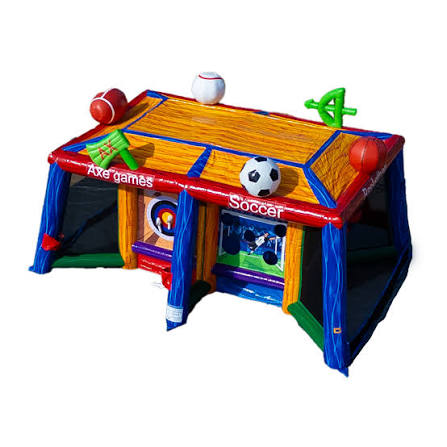
Sports-themed inflatables offer a flexible option for rental companies serving schools, sports clubs, corporate clients, and community organizations. Common examples include inflatable basketball challenges, soccer target games, football throwing activities, and other skill-based attractions.
These games allow participants to test their accuracy and coordination in short, easy-to-understand challenges. Their scoring systems can make them suitable for tournaments, competitions, and promotional activities.
Best Uses for Inflatable Sports Games
Sports games can work particularly well at:
- School sports days and educational events.
- Corporate team-building activities.
- Community festivals and local celebrations.
- Sports club gatherings and tournaments.
- Brand promotions and public engagement events.
When comparing models, consider the intended age group, playing area, scoring features, and number of participants who can safely take part. Products with straightforward rules may be easier for event staff to manage during busy bookings.
3. Inflatable Interactive Games
Interactive inflatable games focus on participation, reaction, coordination, and competition. They may include target challenges, head-to-head activities, reaction-based games, and other formats that encourage players to engage directly with the attraction.
These products can be especially useful for rental businesses serving corporate events, promotional campaigns, university activities, and festivals.
Why They Can Be a Valuable Addition
Interactive games can offer an alternative to traditional bouncing attractions. They may appeal to teenagers and adults as well as younger participants, depending on the design and operating requirements.
Rental operators should review the product’s complexity, setup requirements, power needs, and supervision arrangements. Electronic scoring or other powered features may introduce additional maintenance and troubleshooting considerations.
Choosing an interactive game with clear instructions and a straightforward operating process can help staff manage participation efficiently.
4. Inflatable Slides
Inflatable slides are recognizable attractions for birthday parties, family festivals, school events, and community celebrations. Depending on the design, they may be suitable for different age groups and event sizes.
Some models feature a single sliding lane, while others include multiple lanes or integrated climbing sections. The best choice depends on available space, expected demand, and the venue’s installation requirements.
What Rental Operators Should Check
Before purchasing an inflatable slide, examine its height, landing area, access steps, safety barriers, anchoring requirements, and intended user restrictions.
The surrounding area must provide enough clearance for safe access and operation. Staff should also be able to monitor users and manage queues effectively.
Weather conditions deserve particular attention because wet surfaces can become slippery, and strong winds may make outdoor operation unsafe. Always follow the manufacturer’s instructions and operating limits.
5. Inflatable Sports Arenas and Multi-Player Challenges
Inflatable arenas and multi-player challenge games can provide a defined space for group activities. Depending on the design, they may support team competitions, ball games, interactive challenges, or other supervised activities.
These products can be attractive to corporate clients, schools, universities, sports organizations, and large private events.
For rental businesses, group-oriented attractions may help serve customers who want activities for multiple participants rather than a single-user experience.
Before investing, check the number of participants permitted, the size of the playing area, access arrangements, and any special equipment required. Make sure the game can be transported and installed at the venues your business typically serves.
6. Inflatable Combination Units
Combination units bring multiple activities together in one inflatable structure. A model might include a bouncing area, climbing section, slide, or other play features, depending on its design.
These attractions can be appealing to customers who want variety without renting several separate products.
Benefits for Rental Businesses
A combination unit may help operators offer more activities through a single booking. It can also serve as a prominent attraction at family parties and community events.
However, a larger or more complex unit may require additional transportation capacity, storage space, installation time, and supervision. Buyers should also check whether the structure’s different activity areas have specific age or usage restrictions.
Compare the total operating requirements with the expected demand before choosing a combination unit over smaller, specialized games.
7. Inflatable Target and Accuracy Games
Target-based inflatable games challenge participants to aim at specific zones or objects. Examples may include soccer shooting targets, football throwing challenges, and other accuracy-based activities.
Their simple objective can make them suitable for a wide range of events, particularly where guests need to understand the rules quickly and take turns.
Target games can also support friendly competitions, leaderboards, and promotional activities. Rental operators may find them useful as individual attractions or as part of a larger collection of event games.
When selecting a model, assess the target design, scoring method, replacement components, and required playing clearance. The attraction should be easy to supervise and appropriate for the intended participants.
8. Inflatable Games for Children’s Parties
Children’s birthday parties and family gatherings represent an important market for many inflatable rental companies. Age-appropriate inflatable games can provide an engaging activity while helping hosts organize entertainment for younger guests.
Depending on the product, options may include smaller interactive games, compact obstacle courses, slides, and combination play structures.
Factors to Consider
Choose equipment based on the manufacturer’s age recommendations, participant limits, dimensions, and supervision requirements. A product suitable for older children may not be appropriate for toddlers or very young participants.
Rental operators should also consider the typical size of their customers’ venues. Compact models may be more practical for residential gardens and smaller event spaces, provided the installation area meets all safety requirements.
Clear booking information about dimensions, site access, power needs, and supervision can help prevent misunderstandings on event day.
9. Inflatable Games for Corporate Events
Corporate events create opportunities for rental companies to supply interactive activities that encourage teamwork and friendly competition. Inflatable sports games, reaction challenges, obstacle courses, and multi-player attractions can help employees and guests participate in a shared activity.
These products may be suitable for company celebrations, staff engagement programs, exhibitions, product launches, and team-building sessions.
Corporate clients often value professional setup, reliable scheduling, clear instructions, and efficient event management. Rental businesses should therefore evaluate not only the inflatable itself but also the service requirements associated with delivering it.
Offering a selection of activities with different difficulty levels can help operators accommodate a wider range of participants.
10. Compact Inflatable Games for Smaller Events
Not every customer needs a large obstacle course or a full-size sports attraction. Compact inflatable games can be useful for residential parties, small school functions, indoor venues with suitable clearance, and events with limited installation space.
Smaller products may be easier to transport and store, although their actual packed dimensions and handling requirements should always be confirmed.
For a new rental company, compact attractions may provide a practical starting point because they can help test local demand without immediately committing to several large structures.
However, buyers should not assume that smaller equipment is automatically cheaper to maintain or suitable for every venue. Compare product quality, safety documentation, operating requirements, and expected booking demand before purchasing.
How to Choose the Right Inflatable Games for Your Rental Business
Selecting popular products is only one part of building a successful rental inventory. The equipment must also fit your business model, customer base, and operating capacity.
Identify Your Target Market
Begin by deciding which customers you want to serve. Private birthday parties, school events, corporate gatherings, and public festivals may require different types of equipment.
Research local demand and identify the attractions that potential customers frequently request. Consider the age groups you expect to serve, typical event sizes, and the budgets of your target market.
Set a Realistic Budget
Your investment should include more than the purchase price. Account for shipping, storage, transportation, blowers, anchoring equipment, cleaning, repairs, insurance, and staffing where applicable.
A balanced inventory is often more practical than spending the entire budget on one large attraction. Consider starting with a small selection of complementary products and expanding as booking demand becomes clearer.
Evaluate Durability and Construction
Rental equipment may be transported, inflated, deflated, cleaned, and stored repeatedly. Review material specifications, reinforced areas, seams, anchor points, and the manufacturer’s guidance on intended use.
Ask whether the product is designed for commercial operation and request relevant documentation before placing an order.
Check Safety and Operating Requirements
Review the operating manual, permitted participant limits, age restrictions, anchoring procedures, blower requirements, and weather limits. Confirm the applicable local regulations and inspection requirements for your business.
Establish procedures for setup, supervision, shutdown, cleaning, and inspection before making the attraction available to customers.
Compare Suppliers and After-Sales Support
Choose suppliers who provide clear specifications, transparent quotations, and reliable communication. Ask about warranties, replacement parts, technical assistance, and repair procedures.
For a rental company, access to support can be particularly important when equipment needs maintenance between scheduled bookings.
How to Estimate the Return on Investment
A rental business should evaluate inflatable games as assets that generate revenue over time. The potential return depends on the purchase cost, booking frequency, rental price, operating expenses, and equipment lifespan.
Start by estimating the number of bookings you realistically expect each month. Multiply that figure by the average rental price to estimate gross revenue, then subtract relevant costs.
These costs may include transportation, delivery labor, setup time, cleaning, maintenance, advertising, insurance, storage, and other business expenses.
For example, an inflatable rented regularly at a suitable rate may recover its purchase cost faster than a more expensive product that attracts only occasional bookings. However, demand can fluctuate by season and location, so projections should be conservative.
Track actual booking data after launch and use it to guide future purchases. If a particular category consistently receives more inquiries, expanding that part of your inventory may be more practical than buying products based on popularity alone.
Common Mistakes to Avoid When Buying Inflatable Games
Rental operators can reduce unnecessary expenses by avoiding several common purchasing mistakes.
Choosing equipment based only on appearance: An attractive design may generate interest, but durability, dimensions, safety requirements, and customer demand are equally important.
Ignoring transportation and storage: Large inflatables can require substantial space and suitable vehicles. These expenses should be evaluated before buying.
Overlooking commercial-use requirements: Not every product is designed for frequent rental operations. Confirm the manufacturer’s intended use and follow applicable rules.
Buying too many products too early: Expanding inventory before understanding local demand can tie up capital and increase maintenance costs.
Neglecting staff training: Employees should understand correct installation, anchoring, inspection, supervision, and emergency shutdown procedures.
Failing to plan for weather: Outdoor attractions must be operated within the manufacturer’s permitted conditions, with clear procedures for closing equipment when conditions become unsafe.
Avoiding these mistakes can help rental companies build a more practical inventory and maintain better control over operating expenses.
Conclusion
Inflatable games can provide valuable entertainment options for rental businesses serving parties, schools, festivals, corporate events, and community gatherings. Popular choices include obstacle courses, sports games, interactive challenges, slides, combination units, target games, and compact attractions for smaller venues.
The best inventory depends on customer demand, available capital, transportation capacity, storage space, and the ability to operate equipment safely. Before purchasing, compare product specifications, material quality, warranty coverage, supplier support, and total ownership costs.
By starting with a clear business plan and selecting equipment that matches the needs of your target market, you can build a more flexible rental inventory and make informed decisions as your business grows.