
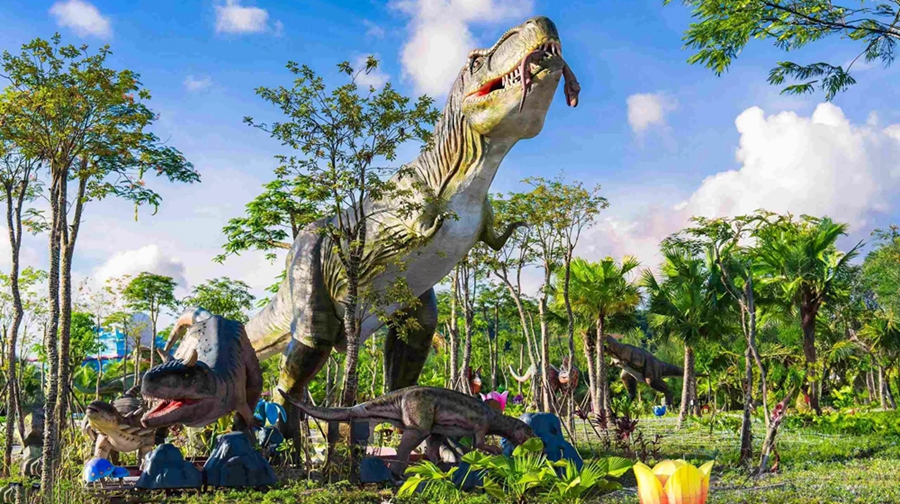
Dinosaur parks aim to create environments where visitors can experience the scale, diversity, and mystery of prehistoric life. Large dinosaur sculptures, themed landscapes, interactive exhibits, and sound effects all contribute to this experience. Among the many species featured in these attractions, Spinosaurus stands out because of its elongated snout, distinctive back sail, and unusual body proportions.
A Giant Animatronic Spinosaurus can become a focal point of a dinosaur park by combining impressive scale with coordinated movement, detailed sculpting, and immersive presentation. Beyond attracting attention, a well-planned installation can support educational storytelling, improve visitor engagement, and help establish the identity of a themed attraction.
Why Spinosaurus Makes an Impressive Park Attraction
Spinosaurus lived during the Cretaceous Period, approximately 100 million years ago, in what is now North Africa. Its distinctive anatomy makes it visually different from many other large predatory dinosaurs, giving designers an opportunity to create an attraction with a recognizable silhouette.
A Distinctive Back Sail
The most recognizable feature of Spinosaurus is its prominent sail-like structure, supported by elongated neural spines extending from its vertebrae. This feature creates a striking outline that can remain visible even when visitors view the dinosaur from a distance.
For a large outdoor installation, the sail can help establish a strong visual landmark. Designers must nevertheless ensure that its proportions and supporting structure are appropriate for the model’s size and intended environment.
An Unusual Head and Body Shape
Spinosaurus had a long, narrow skull and conical teeth, giving it a different appearance from the broad-headed Tyrannosaurus rex. Its body proportions and elongated tail further distinguish it from other familiar dinosaurs.
Accurately reproducing these features helps the attraction stand out without relying solely on exaggerated dimensions. Anatomical references also help designers balance visual impact with scientific credibility.
Opportunities for Prehistoric Storytelling
Spinosaurus is associated with ancient environments in North Africa and is widely studied for its possible adaptations to life in and around water. These characteristics provide useful inspiration for themed landscapes and educational displays.
A park might surround the model with artificial vegetation, rock formations, water features, or interpretive signs. Such elements can establish a setting while explaining which aspects of the reconstruction are supported by fossil evidence and which remain uncertain.
The Engineering Behind Giant Animatronic Models
Creating a large moving dinosaur requires careful coordination between structural engineering, mechanical systems, electronics, and exterior design. Each component must work reliably while supporting the overall appearance of the animal.
Building a Strong Internal Framework
The internal framework supports the dinosaur’s weight and provides mounting points for motors, actuators, joints, and exterior materials. Steel or other engineered structural materials may be used depending on the model’s dimensions and design requirements.
Large installations require careful attention to weight distribution and load transfer. Features such as a long tail, extended neck, or tall sail can affect balance and introduce additional structural demands.
Engineers must also consider wind loads, foundation requirements, and the forces created by repeated movement. Proper structural planning helps ensure that the installation remains stable throughout its intended service life.
Developing Coordinated Movement
Animatronic systems use motors, actuators, and electronic controllers to reproduce selected movements. Depending on the design, a giant Spinosaurus may turn its head, open its jaws, move its neck, or sway its tail.
The most convincing performances rely on coordination rather than the number of moving parts. Gradual transitions, controlled speeds, and carefully timed pauses can make the dinosaur appear more natural.
Movement sequences should also respect the limitations of the mechanical structure. Smooth operation helps reduce unnecessary strain on components and supports more reliable long-term performance.
Integrating Sound Effects
Sound adds atmosphere to an animatronic display. Synchronized jaw movements, low-frequency effects, and environmental audio can make the dinosaur feel more present within its surroundings.
Because the actual vocalizations of Spinosaurus are unknown, roars and similar effects are creative interpretations rather than verified recordings. Parks can still use them effectively while distinguishing imaginative sound design from established scientific knowledge.
Background sounds, such as wind or water, may further reinforce the atmosphere of a prehistoric environment.
Creating a Realistic Exterior
The external finish determines how convincingly the dinosaur resembles a prehistoric animal. Even a large, mechanically sophisticated model can look artificial if its proportions, textures, or paintwork are poorly executed.
Detailed Sculpting and Skin Texture
Artists reproduce the dinosaur’s facial features, scales, skin folds, claws, and other surface details through sculpting and molding techniques. The texture should complement the underlying anatomy rather than obscure it.
Different materials may be used across the model, depending on whether a component needs flexibility or structural rigidity. Silicone, rubber, and specialized foam compounds are possible options for particular exterior applications.
The scale of the detailing also matters. Features must remain visible from the viewing distances expected in a dinosaur park, while closer viewing areas may benefit from finer surface work.
Naturalistic Color and Finishing
The exact skin coloration of Spinosaurus is not known, so designers generally use artistic interpretations when choosing a color scheme.
Earthy browns, muted greens, gray tones, and contrasting undersides can produce a cohesive appearance. Layered painting and subtle shading help define the muscles, facial contours, and back sail.
For outdoor installations, protective coatings are important for reducing deterioration caused by ultraviolet exposure, rain, and routine cleaning. The coating system should be compatible with the underlying materials and appropriate for the local climate.
Positioning the Dinosaur as a Park Centerpiece
A giant animatronic dinosaur becomes more effective when its placement is planned as carefully as its construction. The surrounding layout determines how visitors first encounter the model, where they stop to observe it, and how they move through the attraction.
Creating a Strong Visual Landmark
Placing the dinosaur near an entrance, central plaza, or major pathway can make it an easily recognizable feature of the park. Its height and distinctive silhouette may help visitors orient themselves within a larger themed environment.
However, visibility should be balanced with pedestrian circulation. A model that attracts large crowds needs sufficient surrounding space to prevent congestion and preserve access routes.
Designing Suitable Viewing Angles
Visitors should be able to appreciate the dinosaur’s anatomy from more than one perspective. A clear view of the sail and skull can establish its identity, while side and rear viewing angles reveal other details.
Designers should evaluate sightlines from different distances and consider how landscaping, signs, barriers, and nearby structures affect visibility.
If the model includes moving components, viewing areas must also remain outside the designated mechanical clearance zones.
Integrating the Surrounding Landscape
A themed environment can make the installation feel like part of a larger prehistoric setting. Artificial vegetation, rock formations, textured pathways, and carefully positioned lighting can reinforce the presentation.
For a Spinosaurus display, a wetland-inspired landscape may provide useful context, reflecting scientific interpretations of its ecology. Such scenery should not be treated as a definitive reconstruction of the animal’s exact habitat.
The objective is to create a cohesive visitor experience in which the dinosaur, landscape, and educational elements complement one another.
Educational Opportunities in Dinosaur Parks
A giant animatronic Spinosaurus can provide more than visual entertainment. When paired with informative displays, it can introduce visitors to paleontology, anatomy, ancient ecosystems, and scientific research.
Explaining Distinctive Anatomy
Information panels can identify the dinosaur’s elongated snout, conical teeth, back sail, and other recognizable features. Visitors can compare these characteristics with those of other dinosaur species displayed throughout the park.
This approach helps transform a large model into a visual learning resource rather than simply a photo opportunity.
Introducing Fossil Evidence
Parks can explain how paleontologists use fossilized bones and other evidence to reconstruct extinct animals. Illustrations and diagrams can show how researchers infer body proportions and investigate possible adaptations.
Because scientific interpretations can change as new evidence emerges, exhibits can also explain why some details remain uncertain. This encourages visitors to understand science as an ongoing process of investigation.
Engaging Different Age Groups
Children may respond strongly to movement and sound, while older visitors may be interested in anatomy, fossil discoveries, and the engineering behind the installation.
Combining visual spectacle with accessible information allows the same attraction to appeal to different audiences. Interactive displays and guided educational activities can provide additional context without overwhelming the main experience.
Safety Considerations for Large Outdoor Installations
The scale of a giant animatronic dinosaur creates specific installation and operating requirements. Safety must be considered during design, fabrication, transportation, and daily operation.
Important considerations include:
- Structural stability: Foundations and supports must be suitable for the model’s weight and environmental loads.
- Moving-part clearance: The head, tail, jaws, and other moving components need sufficient operating space.
- Electrical protection: Controls, wiring, and electrical components must be appropriate for the installation environment.
- Visitor management: Barriers, signs, and pathways should keep visitors away from hazardous areas.
- Inspection procedures: Mechanical systems and exterior components should be checked regularly.
Outdoor installations may require additional precautions against strong winds, heavy rain, or other severe weather. Operators should follow engineering recommendations, manufacturer instructions, and applicable local regulations.
Maintenance and Long-Term Reliability
A centerpiece attraction must remain visually appealing and mechanically dependable throughout its operating life. Regular maintenance helps identify wear before it causes significant damage or unexpected downtime.
Inspection routines should cover actuators, joints, structural connections, wiring, sensors, sound systems, and exterior surfaces. Paint damage, loose fasteners, unusual vibration, and inconsistent movement should be investigated promptly.
Weather exposure can accelerate deterioration, particularly where protective coatings have been damaged. Appropriate cleaning procedures and timely repairs help preserve the statue’s appearance.
Maintenance access should be incorporated into the original design. Service panels, replaceable components, and safe access for technicians can make ongoing upkeep more efficient.
Measuring the Value of a Dinosaur Park Centerpiece
A large animatronic installation represents a significant investment, so park operators should consider its practical value alongside its visual impact.
A well-positioned dinosaur may strengthen the park’s identity, create a recognizable landmark, and encourage visitors to explore nearby exhibits. Its effectiveness depends on the overall visitor experience, the quality of the installation, and how well it fits the attraction’s audience.
Before committing to a project, operators should evaluate fabrication costs, transportation, installation, electricity consumption, staffing, maintenance, and expected operating life.
A carefully planned model that operates reliably and complements the park’s wider theme may provide greater long-term value than a larger installation with unnecessarily complex features.
Conclusion
Giant animatronic Spinosaurus models can become memorable centerpieces of dinosaur parks by combining distinctive anatomy, impressive scale, coordinated movement, and immersive surroundings. Their visual presence attracts attention, while carefully designed landscapes and educational information help visitors connect with prehistoric life.
Achieving a successful installation requires more than building a large dinosaur. Structural engineering, realistic sculpting, weather protection, visitor safety, and ongoing maintenance all contribute to its long-term performance. When these elements are planned together, a giant Spinosaurus can serve as both a striking attraction and a valuable starting point for learning about Earth’s ancient past.