
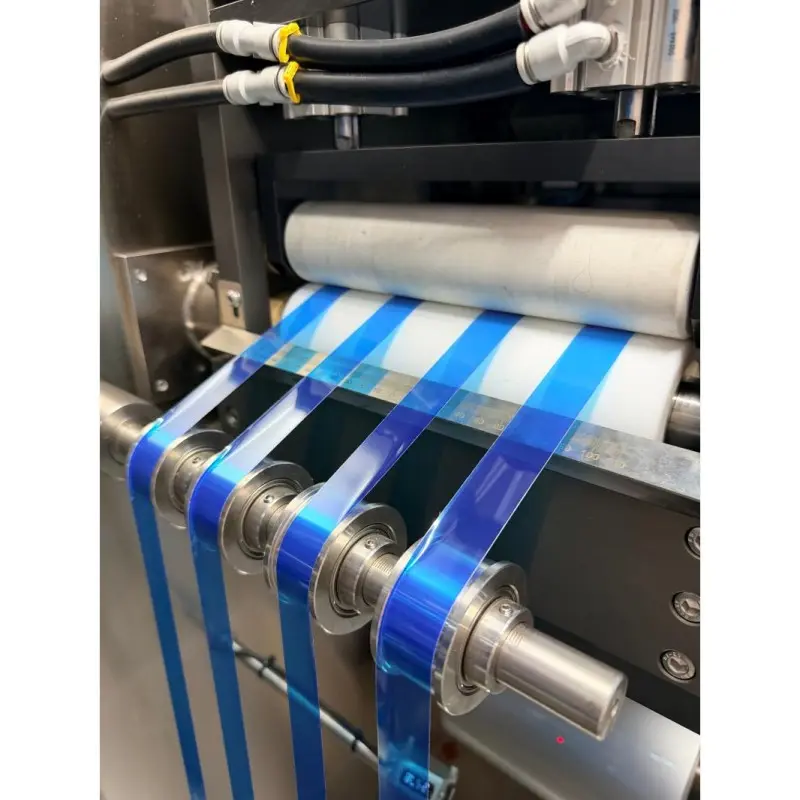
Selecting the right film is an important part of achieving reliable performance in automated soluble packaging. Water-soluble films differ in thickness, strength, flexibility, solubility, and sealing behavior, so not every film will perform identically on every packaging system. A Water Soluble Packaging Machine must be appropriately matched with the film’s physical and processing characteristics.
Water-soluble packaging commonly uses polyvinyl alcohol (PVA)-based films for applications involving measured doses of powders, liquids, gels, or other formulations. POLYVA provides packaging equipment designed for water-soluble film applications. Understanding film compatibility can help manufacturers reduce feeding problems, improve forming and sealing consistency, and maintain stable production.
What Does Film Compatibility Mean?
Film compatibility refers to how well a particular soluble film works with the mechanical and processing requirements of a packaging machine. The film must move through the equipment correctly, form the intended package shape, and create a reliable seal under the machine’s operating conditions.
Compatibility is not determined by one property alone. Film thickness, tensile strength, flexibility, moisture sensitivity, and sealing characteristics can all influence machine performance.
Why Film Properties Matter
The packaging film is an active part of the production process rather than simply an outer covering. Its characteristics directly affect how the machine handles, forms, fills, and seals each package.
If the selected film is unsuitable for the machine or product, manufacturers may experience inconsistent forming, film breaks, poor seals, or other production issues.
Film Thickness
Film thickness can affect both mechanical handling and sealing performance. A thicker film may have different forming and sealing requirements from a thinner film.
The machine’s forming mechanisms and sealing parameters should therefore be appropriate for the selected film specification. Consistency in film thickness is also important because significant variation can affect repeatability during production.
Tensile Strength and Flexibility
The film needs sufficient mechanical strength to pass through the machine without excessive stretching or tearing. At the same time, it must have enough flexibility to form the required cavities or package shapes.
The balance between strength and flexibility depends on the film formulation and intended packaging application. Machine settings should be established according to the manufacturer’s film specifications.
Moisture Sensitivity
One of the most important considerations for water-soluble film is its interaction with moisture. Environmental humidity can affect the film’s handling properties and, in some cases, its sealing or forming behavior.
Manufacturers may need to maintain controlled production conditions and store film in an appropriate environment. Following the film supplier’s storage recommendations can help preserve its intended characteristics.
Sealing Compatibility
A package must be properly sealed after the product has been filled. Different soluble films can have different sealing requirements, including variations in temperature, pressure, and sealing time.
Using inappropriate sealing parameters may result in weak seals, excessive deformation, or other defects. Machine settings should therefore be adjusted based on the specific film rather than applying identical parameters to every material.
Forming Performance
The film must be able to form the required cavity without excessive stretching, cracking, or distortion. Forming performance can depend on film thickness, flexibility, temperature, and machine design.
Consistent cavity formation is particularly important for single-dose packages because it affects both the available filling volume and the final package dimensions.
Compatibility With Different Products
Film selection should also consider the product being packaged. A film that performs well with a dry powder may require different conditions when used with a liquid or gel.
Important product characteristics can include:
- Moisture content
- Chemical compatibility
- Viscosity
- Temperature
- Particle size
- Flowability
- Required storage conditions
The interaction between the film and product should be evaluated before large-scale production begins.
Film Feeding and Machine Alignment
Consistent film feeding is necessary for stable automated production. The film must remain properly aligned as it travels through rollers, forming stations, filling areas, and sealing components.
Film that stretches excessively or does not maintain stable tension can cause alignment problems. Correct machine setup and appropriate tension control can help maintain predictable film movement.
How to Evaluate Film Compatibility
Manufacturers can use a structured evaluation process before committing to a particular film. Testing should consider both machine performance and finished package quality.
A typical evaluation may include:
- Checking the film’s technical specifications.
- Confirming compatibility with the machine’s forming and sealing systems.
- Testing film feeding and alignment.
- Evaluating cavity formation.
- Checking filling and sealing performance.
- Inspecting finished package integrity.
- Monitoring performance under intended environmental conditions.
Small-scale trials can reveal potential issues before full production begins.
Common Film Compatibility Problems
Several production problems can indicate that the film and machine are not properly matched. These may include:
Film Breakage
Repeated tearing can result from unsuitable tension, mechanical stress, film defects, or incorrect machine settings.
Poor Forming
If the film does not form cavities consistently, the issue may involve film flexibility, forming conditions, or machine configuration.
Weak Seals
Weak or inconsistent seals can be associated with unsuitable sealing parameters, contamination in the sealing area, or film characteristics.
Wrinkling or Misalignment
Film wrinkles and tracking problems can affect package appearance and sealing quality. They may be linked to film tension, feeding components, or incorrect alignment.
The Role of Production Conditions
Even a compatible film can perform differently when production conditions change. Humidity, temperature, machine speed, and product characteristics can all influence the packaging process.
Maintaining stable operating conditions makes it easier to identify whether a problem originates from the film, machine settings, or product itself.
Maintenance and Film Performance
Machine maintenance can also affect perceived film compatibility. Worn rollers, sealing components, guides, or other parts may create problems that appear to be caused by the packaging material.
Regular inspection and preventive maintenance help keep the machine within its intended operating conditions. This is particularly important when packaging equipment operates for extended production periods.
Conclusion
Film compatibility is an important factor in the reliable operation of water-soluble packaging equipment. The selected film must work effectively with the machine’s feeding, forming, filling, and sealing processes while remaining suitable for the packaged product.
By evaluating film thickness, strength, flexibility, moisture sensitivity, sealing behavior, and product compatibility, manufacturers can establish more stable production conditions. Proper testing, machine adjustment, environmental control, and maintenance can further support consistent package quality and efficient operation.